On Kingship
In Richard II

In the the first instalment of The Hollow Crown, Ben Whishaw plays an effete, juvenile king. The real Richard II was about 33 when deposed, Christ’s dying age. Towards the beginning, a monkey perches on his shoulder. Alongside Whishaw’s unsettlingly singsong tone and pious smirk, complete with eyes cast to the heavens, this detail draws a fun parallel between the boyish Richard II and the King of Pop, Michael Jackson. Patrick Stewart’s John of Gaunt is magisterial; dying and confined to his chair, he upbraids the king with extraordinary gravitas, so that Richard appears feeble and clownish when he draws his sword in retaliation. Later, as he murmurs ‘This - other - Eden […] this earth, this realm, this England’ you remember that, like Lear, Richard II is a tragedy of collateral damage, and those whose deaths cause the most pathos are attendant characters: noblemen, loyal servants, family members. But we still feel for childlike, tantrum-ing Richard: like the typical Shakespearean tragic hero, the primary emotion he inspires is frustration.
Despite being so skilled with words, King Richard II is a poor reader. His bad interpretation — of the law, of scripture, of other minds — is central to the tragedy. Specifically, Richard’s flaw is that, despite eloquently referring to the Bible quite frequently, he fatally misinterprets the provisions and nature of his own Biblically ordained office.
Richard’s absolutist reading of the prerogatives of kingship would have been particularly noticeable to a legally literature audience in Shakespeare’s England. It is notable that the play was first performed at the house of the Member of Parliament Edward Hoby. Between the 1560s and the 1610s, jurists like Edmund Plowden and Edward Coke produced influential definitions of kingship as an institution which, though sacral, was not absolute but constrained by the laws of God and land. Such commentary frequently looked back to medieval kingship, since the problems caused by monarchic absolutism lay at the heart of the Wars of the Roses. The Bible was always in the back- or fore-ground of discussions of monarchy. If the nature and limits of kingship are to be read Biblically and mystically, then Richard’s hamartia is his claim to divine authority — without it, he considers his crown to be forfeited.
In the first scene of the play we’re plunged into the heart of the conflict: two noblemen, Henry Bolingbroke and Thomas Mowbray, face each other before the royal throne where the King sits in full state. Bolingbroke accuses Mowbray of having murdered Thomas of Woodstock, his uncle. We soon learn that the King himself secretly ordered Woodstock’s death and that Mowbray executed his command – a secret which John of Gaunt, Bolingbroke’s father, suspects. Bolingbroke’s ‘appeal for treason’ was a form of trial which was presented before the king who would, in his office as God’s representative, dispense justice. But here, the king is incapable of delivering justice since he participated in the crime in question. Already, Shakespeare sets out a problem inherent in monarchical government: how might a king, as God’s anointed marshal, be held accountable for his own crimes?
Richard tries and fails to convince the two men to make peace, so a trial by battle must ensue. Richard halts the joust at the last moment, to the disquiet of all present, and banishes both Mowbray and Bolingbroke to exile, though he reduces the latter’s sentence from 10 to 6 years in a display of ineffectual mercy for the sake of the aggrieved John of Gaunt. This recklessly arbitrary decision sets in motion the series of events which leads to the king’s overthrow by Bolingbroke. But the crucial moment, after which Richard’s grasp over his Crown and nation seems ineluctably doomed, occurs after John of Gaunt’s death: the prodigal King seizes his land and money, Bolingbroke’s inheritance, to fund an unpopular war in Ireland which has been exacerbating the penury of his people. Bolingbroke’s rebellion is mobilised.
In Act 3, King Richard — surrounded by adversaries — forfeits the Crown after ostensibly accepting Bolingbroke’s terms of compromise (which is that his inheritance be restored):
What must the King do now? Must he submit?
The King shall do it. Must he be deposed?
The King shall be contented. Must he lose
The name of king? I’ God’s name, let it go. (III.iii.148-151)
To retain what he considers the absolute authority of a king, Richard decides he cannot concede anything to Bolingbroke and must be deposed with God as his witness. He laments at length in beautiful and futile language. Finally, he is murdered in his cell by an ambitious nobleman, Sir Piers Exton, who seeks to please the new King Henry, but who angers him instead with his gratuitous and wasteful gesture, one Henry considers scandalous:
They love not poison that do poison need,
 Nor do I thee. Though I did wish him dead,
 I hate the murderer, love him murderèd.
 The guilt of conscience take thou for thy labor,
 But neither my good word nor princely favor.
 With Cain go wander through shades of night,
 And never show thy head by day nor light.
Exton exits.
 Lords, I protest my soul is full of woe
 That blood should sprinkle me to make me grow.
 Come mourn with me for what I do lament,
 And put on sullen black incontinent.
 I’ll make a voyage to the Holy Land
 To wash this blood off from my guilty hand.
Servingmen lift the coffin to carry it out.
 March sadly after. Grace my mournings here
 In weeping after this untimely bier. (V.vi.38-52)
Richard II dramatises a conceptual war which anticipates the Wars of the Roses. The war is that between two kinds of authority: the prerogative of kingship, springing from divine anointment, and the right of rebellion in times of exceptional crisis. The king fatally interprets his divine right as a right of exceptionality under the law, inviting justified rebellion. The justness of his overthrow, however, does not function — neither in the mind of Shakespeare nor even in the minds of Richard’s adversaries — to mollify the tragedy and shame of the event. To overthrow a tyrant with a sense of sorrow is not something familiar to the modern subject; Shakespeare’s Bolingbroke is curious to us, because he regards his actions as unfortunate but dutiful, a last resort. His professed goal, which is always denied by Richard, is simply to restore his inheritance.
BOLINGBROKE [To Northumberland] Noble lord,
Go to the rude ribs of that ancient castle,
Through brazen trumpet send the breath of parley
Into his ruined ears, and thus deliver:
Henry Bolingbroke
On both his knees doth kiss King Richard’s hand
And sends allegiance and true faith of heart
To his most royal person, hither come
Even at his feet to lay my arms and power,
Provided that my banishment repealed
And lands restored again be freely granted. (III.iii.33-42)
Shakespeare inherited mixed attitudes to Richard and Bolingbroke from his primary source, Raphael Holinshed’s Chronicles of England, Scotland, and Ireland which was first published in 1577. Holinshed had a sympathetic view of the new king Henry, remarking: ‘the very notable example that this Henry duke of Lancaster should be thus called to the kingdom, and have the help and assistance of all the whole realm, who perchance never thereof thought or yet dreamed’. In the Chronicles, Richard’s fall and Bolingbroke’s success are the works of God’s providence, which is ‘to be respected, and his secret will to be wondered at’. Shakespeare’s depiction of Bolingbroke evokes far less feeling than his Richard, who is always exquisitely spoken and intermittently quite wise. I think especially of the Hollow crown speech of III.i: ‘For God’s sake let us sit upon the ground/ And tell sad stories of the death of kings…’.
It is no surprise that seven months after the Essex rebellion and the earl’s execution for treason in 1601, Elizabeth declared to the royal archivist Lambarde: ‘I am Richard II, know ye not that?’. At the end of the Tudor dynasty, there were clear parallels between the play and the Elizabethan situation. Like Elizabeth, Richard II had no children; in the play, York is unofficially his choice of heir, and after him, Edward Rutland, his cousin and favourite. York is a character who seems to have little regard for familial bonds: he allies with Bolingbroke as the power struggle favours him and later exposes his own son, Aumerle, for his plot to betray the new King Henry. He represents loyalty to the mystical body or office of the king, a loyalty which supersedes his relation, as uncle, to the man who sits on the throne. As such, he recalls the theory of monarchy put forward by the Tudor jurist Edmund Plowden (though it isn’t clear that Shakespeare read Plowden directly, it’s not implausible). Plowden reported to a panel of senior judges hearing the case of the Duchy of Lancaster in the late 1560s that:
The King has in him two Bodies, viz, a Body natural, and a Body politic. His Body natural is a Body mortal, subject to all Infirmities that come by Nature or Accident, to the Imbecility of Infancy or old Age, and to the like Defects that happen to the natural Bodies of other People. But his Body politic is a Body that cannot be seen or handled, consisting of Policy and Government, and constituted for the Direction of the People, and the Management of the public weal, and this Body is utterly void of Infancy, and old Age, and other natural Defects and Imbecilities, which the Body natural is subject to, and for this Cause, what the King does in his Body politic, cannot be invalidated or frustrated by any Disability in his natural Body.
Divine anointment as part of the Christian Biblical tradition can be traced back to the first book of Samuel, wherein the prophet Samuel anoints Saul and then David as Messiah ("anointed one"), king over Israel. Richard I of England declared at his trial during the diet at Speyer in 1193: "I am born in a rank which recognizes no superior but God, to whom alone I am responsible for my actions", and it was Richard who first used the motto "Dieu et mon droit" ("God and my right"). Importantly, the Old Testament’s sacral kingship placed constraints on the King, in Deut. 17 16-20:
The king, moreover, must not acquire great numbers of horses for himself or make the people return to Egypt to get more of them, for the Lord has told you, “You are not to go back that way again.” He must not take many wives, or his heart will be led astray. He must not accumulate large amounts of silver and gold.
When he takes the throne of his kingdom, he is to write for himself on a scroll a copy of this law, taken from that of the Levitical priests. It is to be with him, and he is to read it all the days of his life so that he may learn to revere the Lord his God and follow carefully all the words of this law and these decrees and not consider himself better than his fellow Israelites and turn from the law to the right or to the left. Then he and his descendants will reign a long time over his kingdom in Israel.
But King Richard has no regard for biblical constraints on kingship. To make matters worse, he claims to resemble the betrayed and crucified Christ and in doing so imputes a hypostatic union of divinity and humanity within himself as king:
Some of you with Pilate wash your hands
Showing an outward pity; yet you Pilates
Have here deliver'd me to my sour cross,
And water cannot wash away your sin (IV.i.6)
In Richard’s imagination, a king is not subject to human laws like his subjects. Nor does Richard believe that his authority is mediated by the governed; in this sense he exists in a world of his own making. His self-conceived power comes only from above, without being constituted also from below: ‘God save the King, although I be not he,/ And yet Amen, if heaven do think him me’ (IV.I.183-184). Richard calls himself a traitor, but only for giving up his crown; he never acknowledges how he welcomed the rebellion to begin with.
Ernst Kantorowicz famously devoted the second chapter of his 1957 work The King’s Two Bodies to Richard II, restating and expanding on Plowden’s legal fiction. In his words, King Richard embarks on the tragic descent ‘from divine kingship to kingship’s ‘Name,’ and from the name to the naked misery of man’. King Richard’s hamartia is that he considers the integrity of the ‘pompous natural body of a king’ (in his own words) to be prior to that of the political body. If he, the person of Richard, were mentally and physically satisfied, then the wider realm should be too. But, as Kantorowicz clarifies, ‘the sacredness of the power is associated with the invisible political body and with the mystery of the state’, not the natural body of the king. The transcendent dignity of the office of the king is precisely why kings were ‘not rarely charged with having blemished and prejudiced the Crown and the royal Dignity and the heirs Kings of England’. This is what Richard fails or refuses to understand – and it’s a scriptural confusion which is the source of his woes. In Act 5, Scene 5, he admits to being confused by the apparent contradictions in scripture:
The better sort,
As thoughts of things divine, are intermixed
With scruples, and do set the word itself
Against the word, as thus: “Come, little ones,”
And then again,
“It is as hard to come as for a camel
To thread the postern of a small needle’s eye.” (V.v.11-17).
Here, he considers two biblical promises: that the innocent will be saved, and that salvation is denied to the rich. At war in his mind are two clashing soteriological views. Just as the ‘word is set against the word’ is this case, so are the seemingly clashing implications of divinely anointed kingship which we find in the Old Testament – and Richard’s fall comes down to his inability to find some compromising view.
Having welcomed the rebellion, Richard cements it by way of zero-sum thinking. His lack of compromise is most clear in Act 4, when he famously compares the crown to:
a deep well
That owes two buckets filling one another,
The emptier ever dancing in the air,
The other down, unseen, and full of water.
That bucket down and full of tears am I,
Drinking my griefs, whilst you mount up on high. (IV.i.174-9)
For one bucket to ascend the well, the other must sink; one wins, another loses, and the winner takes all, leaving the loser with nothing, being nothing. He would rather forfeit the crown entirely than be brow-beaten into restoring Bolingbroke’s inheritance.
Perhaps unsurprisingly, recent scholarship has attempted to revise Ernst Kantorowicz’s seminal reading of Richard II as ‘the tragedy of the King’s Two Bodies’ and to reject the ‘tragic vision of political theology (inherited from Carl Schmitt), and imagine more affirmative, rational, and democratic alternatives’. Since Schmitt, whom Robin Stewart considers to be a ‘spectre haunting political theology’, was ‘deeply committed to mythic and tragic modes as the only ones appropriate to genuine politics’, some consider it their political duty to downplay the theme or role of tragic sacrality in Shakespeare’s Henriad, especially when discussing the tension between constituted and constituent powers in contemporary times. Stewart’s referenced article is an interesting reading of the Aumerle subplot, the resolution of which has some generically comic features: York finds out his son Aumerle — who served as Henry’s ally in the usurpation of Richard — plans to usurp Henry and threatens to break the news to the new king; Aumerle reaches the king first to beg for a pardon for his as-yet unspecified crime; York and his wife then join the scene; father condemns son; mother begs for son’s forgiveness; forgiveness is granted.
It has elements of farce, but this scene needn’t serve the role Stewart gives it, which is to counteract the play’s allegedly implicit ‘authoritarianism’ by comically but sincerely providing a ‘glimpse into a political order wherein past loyalties and allegiances can be forgiven and re-aligned.’ That we register the play as profoundly tragic does not mean that we, whether trying to read Shakespeare’s mind or not, yearn for some alternative ending to his clash with Bolingbroke. It is that we wish Richard, as a wielder of legitimate constituted power, could have been trusted with it. We imagine the counterfactual.
Given the aforementioned context of the play, to construe the events of Richard II as implicitly supporting elective monarchy as a kind of proto-democratic system would be to take serious interpretative liberties. It would also ignore the tragic flaw at the centre of the action: Richard’s conflation of anointed kingship with absolutism and license to forsake the law of the land. For audiences since those of Jacobean England, Richard’s belief that he exists above the law in the first act, and claims like ‘The breath of worldly men cannot depose/ The deputy elected by the Lord’ would have been registered as ironic in the aftermath of the Wars of the Roses. Respect for the monarch as the head of the body politic was strong, trusting that the monarch would be a healthy head atop a healthy body. One important Biblical element to the medieval theories of kingship which persisted well past Elizabeth’s reign was the Pauline construct of a mystical body described in 1 Corinthians 12: ‘For just as the body is one and has many members, and all the members of the body, though many, are one body, so it is with Christ.’ In this light, Edward Coke at the case of Proclamations of 1611 asserted that ‘the King hath no prerogative, but that which the law of the land allows him’.
Shakespeare does not offer us a chronicle of a medieval monarchic struggle, but an Elizabethan reading of sacral kingship, injecting retroactive wisdom into the play-world which brings King Richard’s follies into relief. His vain invocations of scripture are particularly noticeable. That a king is vulnerable to deposition if the relationship between the king’s two bodies is misread and abused – placing the mystical body politic bearing the immortal dignity of the royal office in subservience to the natural body – reminded Shakespeare’s Elizabethan audience, as it does a modern audience, of the grave duty which befalls kings. In doing so, the play does not pose a political challenge to the institution of kingship, but re-affirms its suitability to tragic drama and, by extension, its extreme capacity to illustrate human wisdom and error — that is, human nature — on the stage. Shakespeare was just doing his job.
If any political messaging can be distilled from the play it is simply that those with a claim to God-given power belie dutiful pragmatism and lawfulness at their peril. Richard is a ‘little one’, in many senses, and he is justly mourned, but one can’t help but wonder whether, if he were a more scrupulous reader of the Old Testament, his tragedy might have been avoided.
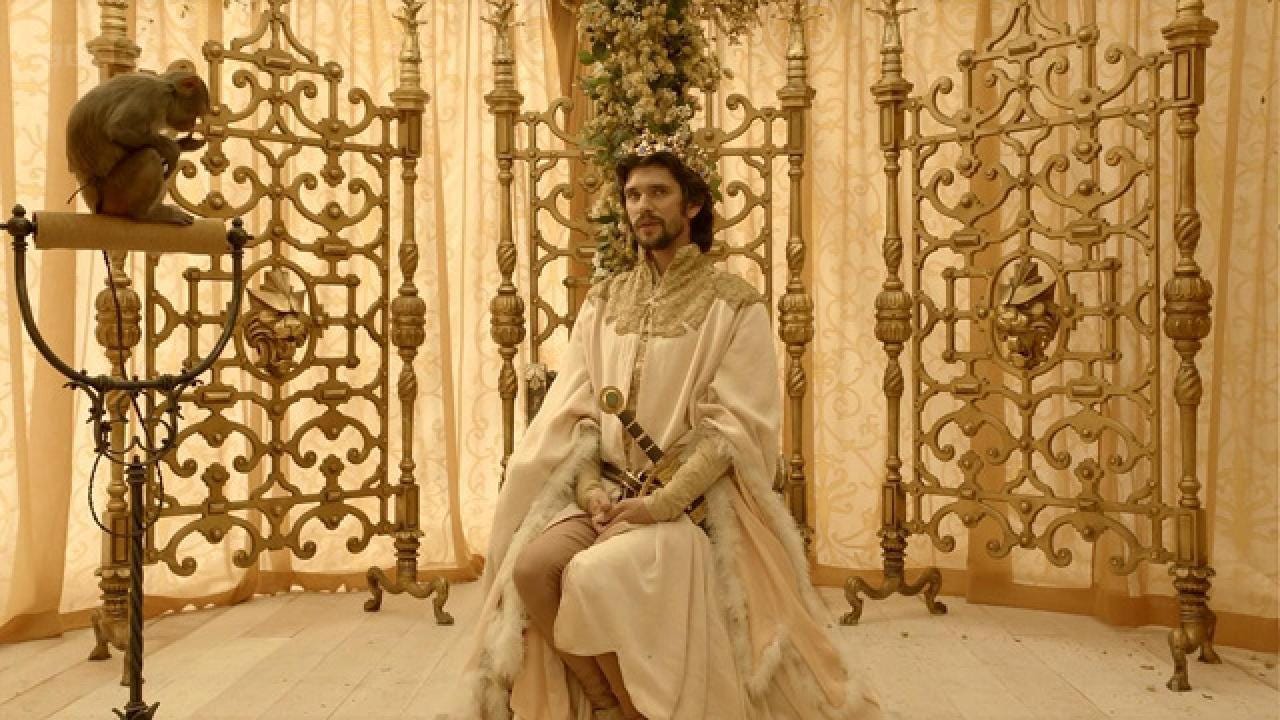
Richard and his monkey. Rupert Goold’s Richard II (The Hollow Crown) (2012)
Who are you?
I want to drink a glass or two to you!
Super essay on one of my favourite Shakespeare plays. I don’t really like the Whishaw depiction though.